
Machine Learning
Machine learning finds patterns in past records and applies them to new ones. It is useful when you hold enough history, the pattern is too intricate to write as rules, and a decision is made often enough for small improvements to add up.
The data decides the outcome. A modest algorithm on clean, well-labelled records will beat an elaborate one on a messy export. So every project here starts with an audit of what you have, and some projects end there.
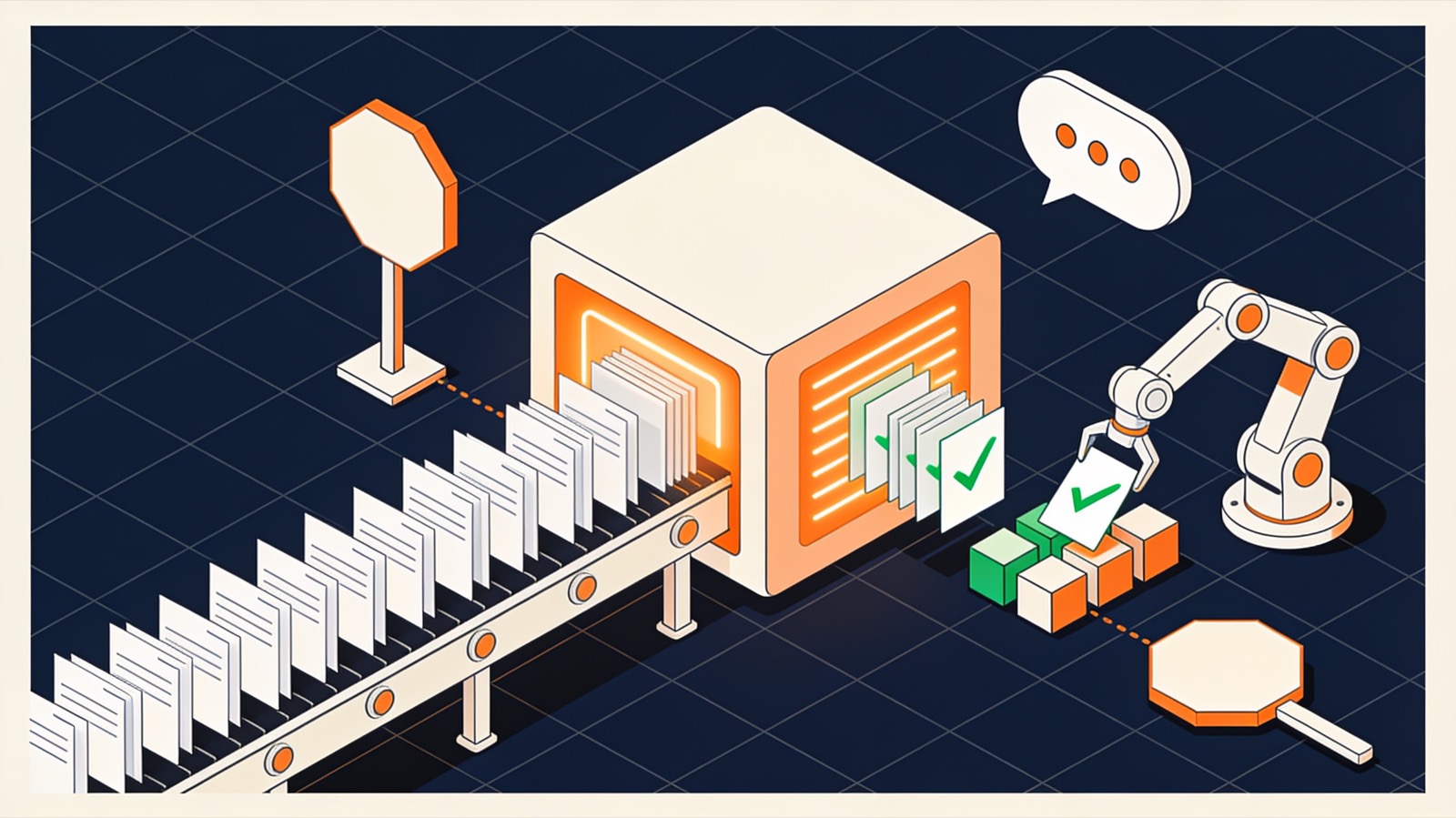
Three kinds of question a model can answer
Nearly every business request falls into one of these.
Which group does this belong to
Classification. Is this transaction suspicious, is this ticket about billing, is this part defective in the photograph. The output is a label and a score for how sure the model is.
How much, and when
Forecasting and regression. Units sold next week, days until payment, energy drawn tomorrow. The output is a number with a range around it.
What should be shown next
Recommendation and ranking. Products for this shopper, articles for this reader, candidates for this vacancy. The output is an ordered list.
What the audit looks for
These are the faults that sink projects. Finding them early is cheap.
Too few examples
A fraud model needs confirmed fraud cases to learn from. If there are forty in the whole history, rules written by an expert will do better.
Labels nobody trusts
Tickets categorised in a hurry, or by a dropdown whose default was never changed. The model learns the habit, not the truth.
Leakage
A column that is filled in only after the outcome is known. The model looks brilliant in testing and useless in production.
Changed definitions
The meaning of "active customer" was altered two years ago and the old rows were never restated.
Gaps and duplicates
Missing months, the same customer under three spellings, test orders mixed with real ones.
Unfair history
Past decisions may reflect bias. A model trained on them repeats it at scale, so sensitive attributes and their proxies are examined.
Stages of a model project
Each stage ends with a decision to continue or stop.
Audit
We profile the tables, report the faults above, and state plainly whether the question can be answered with this data.
Baseline
A simple benchmark comes first: last year same week, the most common class, a short list of rules. Any model must beat it to justify its cost.
Train and test
Models are fitted on one part of the history and judged on a later part they have never seen. Results are reported in business terms, such as missed cases and false alarms.
Shadow run
The model scores live records without acting on them. Its output is compared with what your staff decided.
Release and watch
Input data and prediction quality are monitored. When behaviour drifts, the model is retrained or withdrawn.
Libraries and platforms
For tabular business data, gradient-boosted trees remain hard to beat. Deep learning is kept for images, audio and text.
- Languages
- PythonSQL
- Tabular models
- scikit-learnXGBoostLightGBM
- Deep learning
- PyTorchHugging Face Transformers
- Data handling
- pandasPolarsDuckDB
- Tracking and serving
- MLflowFastAPIDocker
- Cloud
- AWSAzureGoogle Cloud
Should this be a model at all?
A model is justified when
- You have a long record of past cases with known outcomes.
- The decision is repeated hundreds of times a month or more.
- Being slightly better on average has clear monetary value.
- Someone will act on the predictions and can tolerate some being wrong.
Use rules or a report when
- An experienced employee can state the logic in a page.
- Each decision must be explained in full to a customer or regulator and a score will not do.
- The data began to be collected last quarter.
- Nobody has decided what will be done differently once the prediction exists.
What machine learning work costs
Our rates are published. Pick the role and move the sliders for an indicative budget.
Rate card
| Role | Hourly | Monthly* |
|---|---|---|
| Frontend / WordPress | AED 110 | AED 17,600 |
| Backend / API | AED 118 | AED 18,880 |
| Full-stack | AED 129 | AED 20,640 |
| Mobile (React Native / Flutter) | AED 129 | AED 20,640 |
| DevOps / Cloud | AED 147 | AED 23,520 |
| AI / Automation engineer | AED 165 | AED 26,400 |
| QA / Test engineer | AED 92 | AED 14,720 |
| UI / UX design | AED 103 | AED 16,480 |
*160 hrs/month full-time. Rates are indicative for planning, in UAE dirhams (converted from our US-dollar rates at the fixed peg of 3.6725), before VAT where applicable, and depend on seniority, contract length and timezone overlap. Longer engagements and multi-role teams are discounted — ask.
Before starting
How accurate will the model be?
Unknown until it is tested on your data, and we do not quote figures in advance. After the baseline stage you will have measured numbers to judge by.
How much data is enough?
It depends on how rare the outcome is and how many factors drive it. The audit answers this for your case.
Does our data leave our systems?
Training can run inside your own cloud account or on your server. Where a copy is needed for development, it is pseudonymised and the terms are in the agreement.
Can a large language model do this instead?
For reading and classifying text, often yes, and with less setup. For numeric forecasts on tables, a purpose-trained model is usually cheaper and more dependable.
Who maintains it afterwards?
Your team with our documentation, or us on a monthly retainer. A model left unattended degrades as the business changes.
Tell us the decision you want to improve
Describe the decision, how often it is made, and what records exist. A sample export helps but is not needed yet. Our reply follows within one business day.