
AI and Automation Consulting
Most companies do not have an AI problem. They have a handful of repetitive tasks that eat hours each week, and a suspicion that software could do some of them. The useful question is which ones, and at what cost.
We look at the tasks themselves: who does them, how often, what goes wrong, and what a mistake costs. Some turn out to suit a language model. Many suit a plain script or a rule in a tool you already pay for. A few should stay with a person, and we will say so.
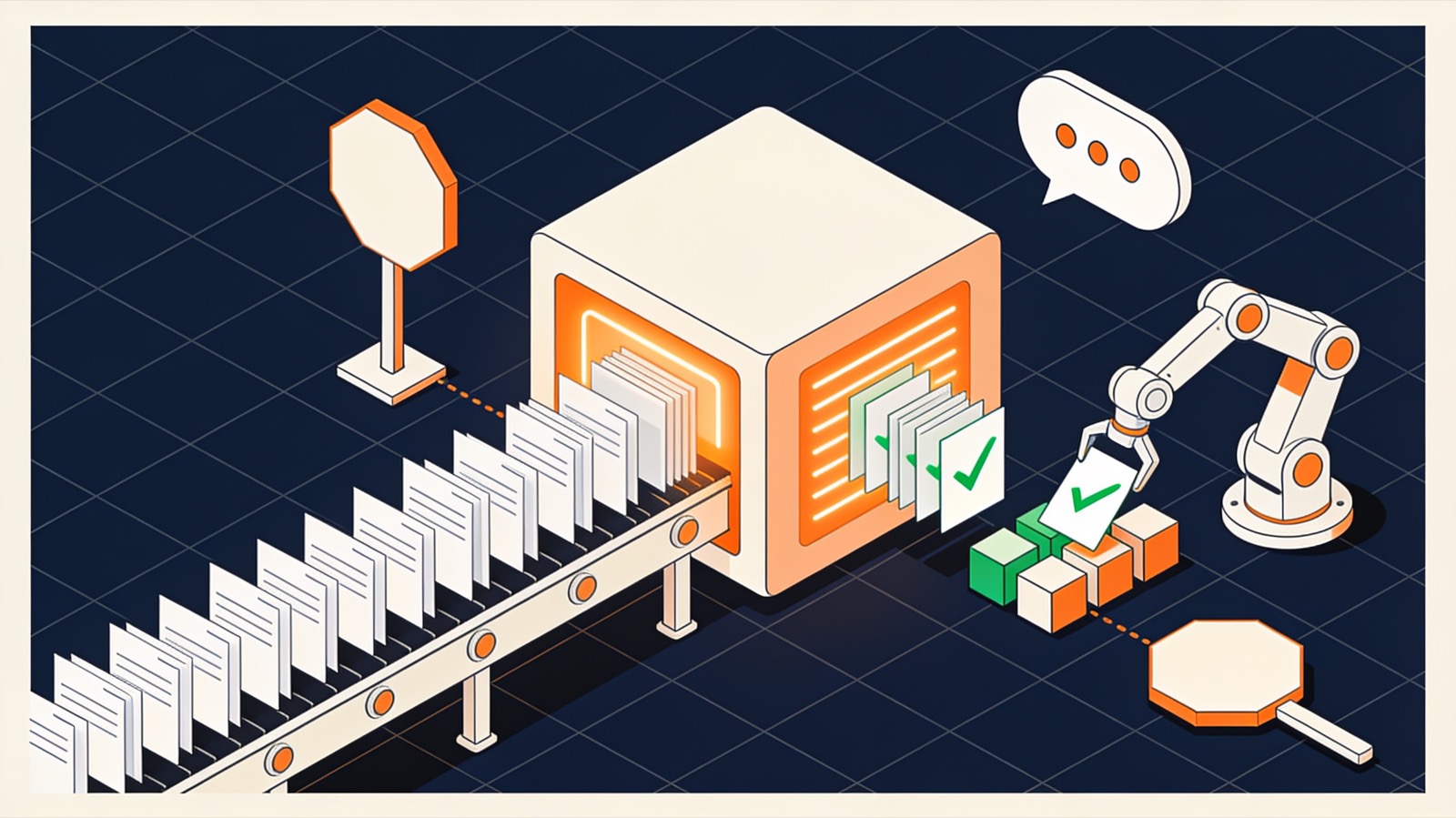
Tasks that usually repay automation
Volume alone is not enough. A good candidate is frequent, follows a pattern, and has a cheap way to catch errors.
Reading documents into a system
Invoices, purchase orders and application forms arrive as PDFs or scans. Extraction software fills the fields and a clerk confirms the ones it marked as doubtful.
Sorting incoming messages
Support email and web enquiries are tagged by topic and urgency, then routed to the right queue. Nothing is answered automatically at this stage.
Drafting routine replies
A model writes a first version from your own knowledge base. A member of staff edits and sends it.
Copying data between tools
An order in the shop becomes a row in accounts and a ticket for the warehouse, with no one retyping it.
Weekly reports
Figures pulled from three systems into one sheet every Monday. This is scheduling and SQL, not artificial intelligence.
Searching internal knowledge
Policies, manuals and past tickets become searchable in plain language, with a link to the source page beside every answer.
Automate it, or leave it alone?
Worth automating when
- The task happens many times a week and the steps rarely change.
- A wrong result is noticed quickly and is cheap to correct.
- The inputs already exist in digital form, or can be made so.
- Somebody owns the process and can say what a correct result looks like.
Better left to a person when
- It happens a few times a year and each case is different.
- An error reaches a customer, a regulator or a bank account before anyone sees it.
- The process itself is disputed inside the company.
- Building and maintaining the automation costs more than the hours it returns.
How the review runs
The review is paid work with a written result. You are free to take the report to any builder.
Watch the work
We sit in on calls or screen shares with the staff who do each task, and record the steps, the exceptions and the time taken.
Measure and rank
Each task gets an estimate of hours spent, error cost and build effort. The list is sorted by return, not by how interesting the technology is.
Choose the method
For every task near the top we name the simplest approach that would work: a setting in existing software, an integration, a script, or a model.
Pilot one task
The first build is small and runs beside the manual process. A person checks its output until the error rate is known.
What is in the report
A document written for the owner of the business, not for engineers.
- Every reviewed task, with hours per month as measured
- A recommended method for each, or a reason to leave it
- A build estimate given as a range
- Running costs, including model usage fees where they apply
- What could go wrong and how it would be detected
- Which personal or confidential data the task touches
- The order in which we would do the work
- Tasks we advise against automating, and why
What automation work costs
Our rates are published. Pick the role and move the sliders for an indicative budget.
Rate card
| Role | Hourly | Monthly* |
|---|---|---|
| Frontend / WordPress | AED 110 | AED 17,600 |
| Backend / API | AED 118 | AED 18,880 |
| Full-stack | AED 129 | AED 20,640 |
| Mobile (React Native / Flutter) | AED 129 | AED 20,640 |
| DevOps / Cloud | AED 147 | AED 23,520 |
| AI / Automation engineer | AED 165 | AED 26,400 |
| QA / Test engineer | AED 92 | AED 14,720 |
| UI / UX design | AED 103 | AED 16,480 |
*160 hrs/month full-time. Rates are indicative for planning, in UAE dirhams (converted from our US-dollar rates at the fixed peg of 3.6725), before VAT where applicable, and depend on seniority, contract length and timezone overlap. Longer engagements and multi-role teams are discounted — ask.
Asked before a review
Will this reduce our headcount?
We do not sell automation as a way to replace staff and make no claim about it. In practice the hours returned go to work that was being postponed.
How accurate are language models?
It varies by task, and we will not quote a figure before testing on your own material. Models make mistakes, so a person reviews anything sent to a customer or anything that moves money.
Is our data used to train a model?
That depends on the provider and the plan. We read the terms with you, choose an option that excludes training where one exists, and record the choice in the report.
Do we need new software?
Often not. Accounting, help desk and CRM products now include rules and integrations that many customers never switch on. We check those before proposing a build.
Who owns what is built?
You do. Code goes into your repository, and model and cloud accounts are opened in your company name.
Name three tasks your team dislikes
Write down the three jobs that take the most time for the least thought. That is enough for a first conversation. An answer comes back within one business day.