
Software for Retail
Retail margins are thin, so small errors matter. An item shown as available that is not on the shelf becomes a refund and an unhappy customer. A price changed on the website but not at the till becomes an argument at the counter.
Most of these errors come from stock, prices and orders being kept in more than one place. We build the software that keeps one version of each and pushes it to the shop floor, the website and the marketplaces. Often that is an integration between products you already pay for, not a new system.
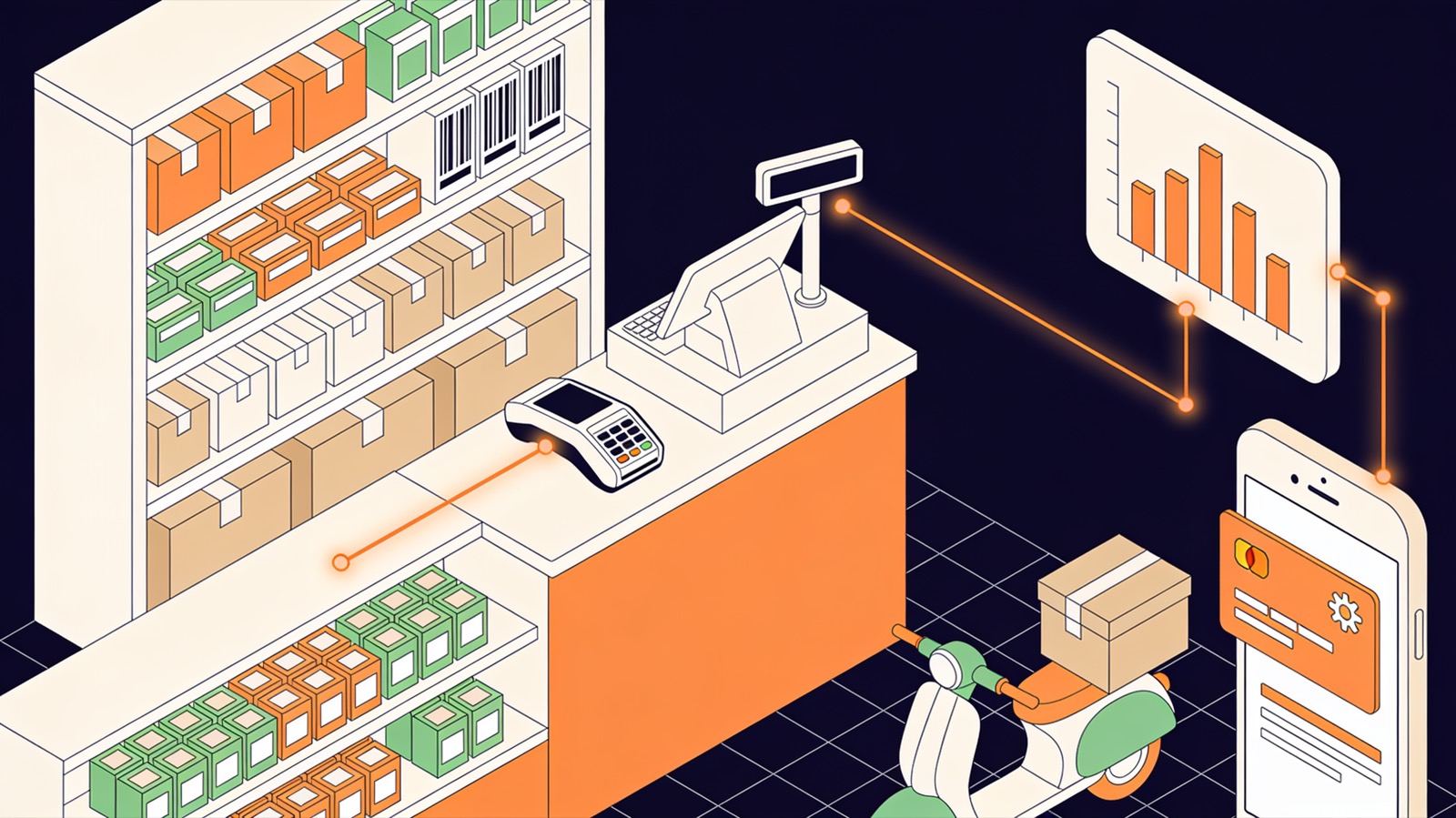
What goes wrong between shelf and checkout
Overselling
The last unit sells in the shop at noon and online at five past, because the website learns about stock once a night.
Price and promotion mismatches
A discount is set up in three systems by three people. One of them mistypes the end date.
Returns nobody can trace
Goods come back to a branch that did not sell them, and the refund, the stock and the accounts each tell a different story.
Marketplace listings kept by hand
Titles, images and quantities are copied into each marketplace separately and go stale within a week.
A slow site on the busiest day
Traffic peaks during a sale, pages take seconds to load, and baskets are abandoned.
Buying by instinct
Reorder decisions rest on what the manager remembers selling, because the sales report takes a day to prepare.
Systems retailers ask for
Listed roughly from the smallest job to the largest.
Stock synchronisation
A service that listens to sales from every channel and updates the others within seconds, with a safety buffer per product.
Product information management
One place for descriptions, images, sizes and barcodes, publishing to the website, marketplaces and printed labels.
Order management
Orders from all channels in a single queue, split by warehouse or branch, with pick lists, courier labels and tracking emails.
Online shops
Built on WooCommerce, Shopify or a custom application, depending on catalogue size and how unusual your pricing rules are.
Click and collect, and returns
Reservation of stock at a branch, a collection code, and a returns flow that puts the item back on sale.
Loyalty and gift cards
Balances that work the same at the till and online, with a ledger behind them so finance can account for the liability.
Sales and margin reporting
Daily figures by product, branch and channel, including the cost of returns and delivery.
What stays with the retailer
If we part company, the business keeps running on what it already holds.
- Shop, domain and hosting accounts registered to you
- Payment processor contract in your company name
- Source code of every integration, in your repository
- Import and export scripts for the product catalogue
- Notes from a load test carried out before a major sale
- A rollback procedure for a release that misbehaves
- Analytics and advertising accounts under your login
- A plain-language guide for shop staff
Rules a retailer has to settle first
Your accountant and legal adviser give the answers. We then build to those answers. Any audit or certification is the work of your auditor.
Card payments
PCI DSS governs anyone accepting cards. Using the processor's hosted payment page or terminal keeps card numbers away from your own systems.
Sales tax
GST in India, VAT in the United Kingdom and European Union, state sales tax in the United States. Rates, invoices and cross-border thresholds all differ.
Consumer rights
Cancellation periods, refund deadlines and the information that must appear before the customer pays vary by country.
Privacy and marketing consent
GDPR, India's data protection act and cookie rules decide what you may track and whom you may email.
Accessibility
The European Accessibility Act and similar laws apply to online shops. WCAG is the usual technical yardstick.
Product identifiers and labelling
GS1 barcodes, age-restricted goods, and category rules for food, cosmetics or electrical items.
Budget for a retail project
Our rates are published. Pick the role and move the sliders for an indicative budget.
Rate card
| Role | Hourly | Monthly* |
|---|---|---|
| Frontend / WordPress | AED 110 | AED 17,600 |
| Backend / API | AED 118 | AED 18,880 |
| Full-stack | AED 129 | AED 20,640 |
| Mobile (React Native / Flutter) | AED 129 | AED 20,640 |
| DevOps / Cloud | AED 147 | AED 23,520 |
| AI / Automation engineer | AED 165 | AED 26,400 |
| QA / Test engineer | AED 92 | AED 14,720 |
| UI / UX design | AED 103 | AED 16,480 |
*160 hrs/month full-time. Rates are indicative for planning, in UAE dirhams (converted from our US-dollar rates at the fixed peg of 3.6725), before VAT where applicable, and depend on seniority, contract length and timezone overlap. Longer engagements and multi-role teams are discounted — ask.
Asked by shop owners and operations managers
Do we have to replace our till system?
Usually not. If the point-of-sale product has an API or a reliable export, we connect to it. Discovery establishes that before anything is promised.
Shopify, WooCommerce or custom?
A hosted platform suits a standard catalogue and saves upkeep. WooCommerce gives more control for a store already on WordPress. A custom build is justified only when pricing, bundles or fulfilment rules defeat both.
Can you move our shop from one platform to another?
Yes. Products, customers and order history are migrated in rehearsals first, and old URLs are redirected so existing links keep working. Search positions can still shift after a move, and nobody can promise otherwise.
When can changes go live during peak season?
Most retailers freeze releases before their busiest weeks. We agree the freeze dates with you at the start and plan around them.
What will a retail project cost us?
By the hour at published rates, or as a fixed sum for a first release once a paid discovery has defined it. You see working software every two weeks.
List your sales channels and your till
Name the systems in use and the mistake that keeps recurring. A first conversation needs no more than that. Expect our answer within one business day.